Our Technical Team are available –
Mon to Thurs: 8.30am-4.30pm
Fri: 8.30am – 2.30pm
We offer a range of support outside these hours from our customer support area.
Our Technical Team are available –
Mon to Thurs: 8.30am-4.30pm
Fri: 8.30am – 2.30pm
We offer a range of support outside these hours from our customer support area.
The table below shows the warranty periods for each of our products:
| Range | Product | Duration |
|---|---|---|
| GravityBooster | Ora | 1 years warranty |
| GravityBooster | CT Xtra | 3 years warranty |
| GravityBooster | CT Bathroom | 3 years warranty |
| GravityBooster | CT Force | 5 years warranty |
| GravityBooster | Right Pump | 3 years warranty |
| MainsBooster | TapBoost | 1 years warranty |
| MainsBooster | CombiBoost | 1 years warranty |
| MainsBooster | HomeBoost | 3 years warranty |
| MainsBooster | AccuBoost | 3 years warranty |
We’ve engineered our pumps to be some of the quietest in the UK. CT Xtra, CT Force, HomeBoost and Right Pumps have been independently tested against compeititor products and so we can officially say that we have some of the quietest pumps on the market, and have been awared the Quiet Mark. It is worth mentioning that there is some noise associated with the operation of all of our products.
We have a range of training tools including:
Visit the Downloads page to access all of Salamander Pumps downloadable content, including brochures, installation manuals and datasheets.
We offer a range of accessories that will ensure a smooth installation, protect the products from damage caused by aeration, dry running, excessive temperatures and can help to dampen noise.
You can view the all available accessories on our shop.
The Customer Support section offers guidance on pre installation, installation and post installation enquiries, including FAQs, videos, downloads and articles. For support relating to your product’s warranty, visit the Warranty Support section, where you can request a replacement product, site survey or a service engineer visit.
To successfully activate the pump on first operation: Connect the pump to the pipework, turn on incoming water supply and ensure that all isolating valves are open. Open an outlet and check for natural flow. Ensure all air is purged from the system and inspect connections and connecting pipework for leaks. Plug in electrical supply to pump and turn on. The flow will now increase as the pump activates. Close the outlet fully and the pump will stop.
Shower pumps are designed to improve the water pressure in a gravity fed system by increasing the volume of water which is pumped through the pipes. We manufacture two types of pumps which work in slightly different ways.
Regenerative shower pumps, such as our CT Xtra, CT Bathroom and CT Force ranges, have a water wheel impeller inside the end of the pump. Water enters the shower pump through the inlet, the impeller spins the water around inside the impeller casing, building pressure as the water travels around the end of the pump. Between the inlet and the outlet of the shower pump there is a stripping block, this strips the water from the impeller and directs the water out of the top of the pump.
Our ORA and Right Pump ranges are centrifugal pumps. To increase the water pressure in a system these pumps utilise centrifugal force. Water enters through the inlet on the end of the shower pump, filling the impeller chamber and the impeller. As the impeller spins, water is forced outwards using centrifugal force, this builds higher pressure within the chamber which thrusting water out the top of the pump.
This method of increasing pressure results in a higher flow efficiency than with a regenerative shower pump, so installations with multiple bathrooms can benefit from installing a centrifugal pump. There is also no need to strip the water from the impeller as centrifugal force directs the water out of the pump, this makes centrifugal pumps quiet.
A shower pump is a device that boosts water pressure in your pipes by increasing the volume of water which is pumped through them. The improved water pressure is visible at the showerhead where the force of the spray increases as the pressure and flow rate become stronger.
There are three main types of hot water system in the United Kingdom – gravity fed, mains fed: combination boiler, and mains fed unvented cylinder.
Gravity fed
Mains fed: Combi boiler
Mains fed: Unvented
Click here for more information on identifying your water system
If you live in an older property, there is a good chance you have a gravity fed system. Renowned for poor water pressure and flow.
A gravity fed system consists of a large cold water storage tank usually located in the loft and a hot water cylinder located in an airing cupboard. These systems rely on gravity to force water around the system, with the height of the cold-water storage tank determining the pressure throughout the system.
Cold water is delivered to a cold-water storage tank from the water mains. Cold water from the cold-water storage tank is then supplied to the outlets around the system, such as taps, toilets, showers and baths. Once an outlet requiring hot water is opened, gravity will force cold water from the cold-water storage tank into the hot water cylinder, this will then force hot water out from the top of the cylinder, delivering hot water to the open outlet.
We want to make getting in touch with us as easy as possible. So, have a range of resources available to help you including troubleshooting articles, FAQs and videos.
If you need further support, you can contact us via one of the following methods. If you’re contacting us about a pump in your home, please make sure you have your serial number to hand before you call us.
Low water pressure can be caused by poor natural head on a gravity system, or an increase in demand ie if more than one outlet is used at the same time, or an extension/ new bathroom etc has been added to a property. On mains fed systems, water pressure will vary throughout the day and at peak demand times a drop in performance may be noticed. Other contributors to low water pressure may include poor plumbing or blocked pipework, blocked filters, bent AV Couplers/ hoses and air in the system.
The water pressure can vary when the hot and cold water are supplied in different ways, such as when the hot water is supplied by a gravity fed system and the cold water is supplied directly from the mains. This can be seen when running a mixer tap and the pressure of the mains fed cold water is fine, but the gravity fed hot water pressure is poor.
It is possible to overcome this by using a universal, single ended pump to improve the gravity fed hot water pressure. If the hot water is supplied via a hot water cylinder, check for any blockages or restrictions in pipework that could be effecting the performance.
Our range of water boosting solutions offer a solution to low water pressure and/or flow.
If you have a gravity fed system, installing a shower, bathroom or whole house pump from our GravityBooster range can resolve the low water pressure in the home.
If you have a mains fed system, such as a combination boiler or an unvented cylinder, one of our MainsBooster inline pumps or accumulator products will improve the water pressure and flow.
If you suffer from poor water pressure in your home one of our products can offer the perfect solution to boosting water pressure and/or flow. The results are; improved shower performance, quicker bath fill and strong flowing taps.
However, it is important to make sure that you get the right pump for your system. Use our product selector to help you find the right product.
Depending on the type of pump you have the serial number will be on a label attached to the top of the pump, on the vessel attached to the top of the pump, or on HomeBoost and CombiBoost it will be on the underside of the pump.
You can also find the serial number on a sticker on the back of your installation manual.
We regularly receive queries from customers who are concerned that their pump has already been used because they find water inside the pump while unboxing it. However, the quality testing carried out before our products leave the factory means that they may contain water upon purchase.
There are multiple factors that will impact which is the best shower pump for your home.
Use our product selector tool to find the right product.
A shower pump is a device that boosts water pressure in your pipes by increasing the volume of water which is pumped through them. The improved water pressure is visible at the showerhead where the force of the spray increases as the pressure and flow rate become stronger.
There are three main types of hot water system in the United Kingdom – gravity fed, mains fed: combination boiler, and mains fed unvented cylinder.
Gravity fed
Mains fed: Combi boiler
Mains fed: Unvented
Click here for more information on identifying your water system
If you live in an older property, there is a good chance you have a gravity fed system. Renowned for poor water pressure and flow.
A gravity fed system consists of a large cold water storage tank usually located in the loft and a hot water cylinder located in an airing cupboard. These systems rely on gravity to force water around the system, with the height of the cold-water storage tank determining the pressure throughout the system.
Cold water is delivered to a cold-water storage tank from the water mains. Cold water from the cold-water storage tank is then supplied to the outlets around the system, such as taps, toilets, showers and baths. Once an outlet requiring hot water is opened, gravity will force cold water from the cold-water storage tank into the hot water cylinder, this will then force hot water out from the top of the cylinder, delivering hot water to the open outlet.
A gravity fed system is identified by a cold-water storage tank, usually stored in a loft, and a hot water cylinder. These systems rely on gravity to force water around the system, with the height of the cold-water storage tank determining the pressure throughout the system.
Cold water is delivered to the cold-water storage tank from the water mains. Cold water from the cold-water storage tank is then supplied to the outlets around the system, such as taps, toilets, showers and baths.
The cold-water storage tank also feeds the hot water cylinder, where a heating coil from the boiler or immersion heater will cause the cold water to become hot. Once an outlet requiring hot water is opened, gravity will force cold water from the cold-water storage tank into the hot water cylinder, this will then force hot water out from the top of the cylinder, delivering hot water to the open outlet.
It is common for gravity fed systems to suffer with low pressure, installing one of our gravity fed shower pumps can help to improve the pressure, click here to see our range gravity-fed shower pumps.
Gravity-fed systems are either positive or negative head. Before choosing a gravity-fed shower pump it is important to know whether your system is positive head of negative head, click here for further information.
If you’re unsure which product you need read our guide to selecting the right product, or use our product selector tool.
A mains fed system is one which is fed directly by the mains water such as a combination boiler or an unvented hot water cylinder.
A gravity-fed system is either positive or negative head. In a positive head system a water flow rate of at least 2L/min exists from gravity alone. In negative head systems the water flow rate is less than 2L/min.
When choosing which pump you need it is important to know if the system is positive or negative head as incorrect selection can mean the pump won’t work.
A positive head pump will only work in a positive head system and a negative head (universal) pump will work in both a positive and negative head system, so if you are not sure choose a negative head pump.
Click here to learn how to determine if your system is suitable for a positive head pump.
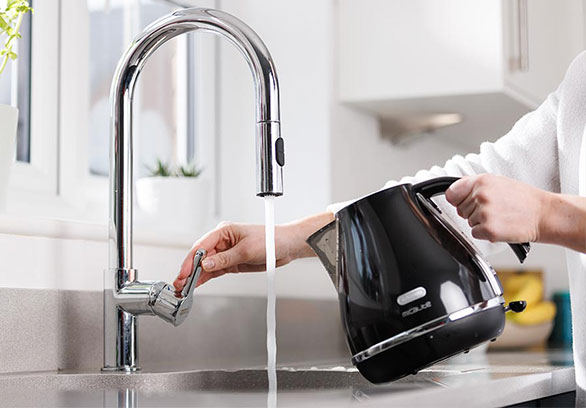
A positive head pump will activate when a minimum flow of water passes through the pump and out of the pumped outlet, such as a shower or tap, naturally (without assistance from the pump). The minimum flow rate required for our positive head pumps is 2 litres of water per minute (L/min). Click here to see what this flow rate looks like from a tap.
You will need to measure the flow rate to determine if a positive head pump is suitable for your system. You will need to test all outlets, such as showers and taps, that are going to be pumped to determine if they have the required minimum flow rate of 2L/min. Watch our video to learn how to measure the water flow rate.
If you cannot measure the water flow rate, then you can check if the system is suitable for a positive head pump if there is more than 600mm between the base of the cold-water storage tank and the highest point in the system after the pump. For example, the illustration to the right shows a shower with pipework below the dotted line indicating the 600mm point.
If you are unable to achieve the minimum flow rate of 1 litre per 30 seconds from all outlets that are to be pumped you will need to install a negative (universal) head pump.
Measuring the water flow is an important step in choosing the right pump. Water flow rate is measured in litres per minute (L/min).
To measure the water flow rate, you will need a measuring jug and a timer.
For example, if you gathered 600ml in 10 seconds, to calculate the flow rate in litres per minute – 600 x 6 = 3600ML per minute = 3.6L/min.
There are multiple factors that will impact which is the best shower pump for your home.
Use our product selector tool to find the right product.
Shower pumps are designed to improve the water pressure in a gravity fed system by increasing the volume of water which is pumped through the pipes. We manufacture two types of pumps which work in slightly different ways.
Regenerative shower pumps, such as our CT Xtra, CT Bathroom and CT Force ranges, have a water wheel impeller inside the end of the pump. Water enters the shower pump through the inlet, the impeller spins the water around inside the impeller casing, building pressure as the water travels around the end of the pump. Between the inlet and the outlet of the shower pump there is a stripping block, this strips the water from the impeller and directs the water out of the top of the pump.
Our ORA and Right Pump ranges are centrifugal pumps. To increase the water pressure in a system these pumps utilise centrifugal force. Water enters through the inlet on the end of the shower pump, filling the impeller chamber and the impeller. As the impeller spins, water is forced outwards using centrifugal force, this builds higher pressure within the chamber which thrusting water out the top of the pump.
This method of increasing pressure results in a higher flow efficiency than with a regenerative shower pump, so installations with multiple bathrooms can benefit from installing a centrifugal pump. There is also no need to strip the water from the impeller as centrifugal force directs the water out of the pump, this makes centrifugal pumps quiet.
A flange is a device that limits the amount of air entering a pump from the hot water cylinder. Air in the system is called aeration and it can cause problems such as fluctuations in water temperature, noisy pipework and in the case of the pump, damage to internal components. Fitting a flange will prolong the life of a pump, and for the Salamander Right Pump range a flange is a requirement of the installation to ensure a valid warranty. It is always best practice to fit a flange in any shower pump installation in a gravity fed system.
A shower pump is a device that boosts water pressure in your pipes by increasing the volume of water which is pumped through them. The improved water pressure is visible at the showerhead where the force of the spray increases as the pressure and flow rate become stronger.
If you live in an older property, there is a good chance you have a gravity fed system. Renowned for poor water pressure and flow.
A gravity fed system consists of a large cold water storage tank usually located in the loft and a hot water cylinder located in an airing cupboard. These systems rely on gravity to force water around the system, with the height of the cold-water storage tank determining the pressure throughout the system.
Cold water is delivered to a cold-water storage tank from the water mains. Cold water from the cold-water storage tank is then supplied to the outlets around the system, such as taps, toilets, showers and baths. Once an outlet requiring hot water is opened, gravity will force cold water from the cold-water storage tank into the hot water cylinder, this will then force hot water out from the top of the cylinder, delivering hot water to the open outlet.
Shower pumps for a gravity fed system are either positive head or universal (negative head). When choosing the pump you need it is important to know if you need a positive head or universal (negative head) pump as incorrect selection can mean the pump won’t work.
A positive head pump is designed to assist and improve the natural flow of water. A flow switch set to activate positive head pumps when a flow rate of 2 litres per minute (L/min) passes naturally through the pump. Therefore, a minimum flow rate of 2L/min must be achieved naturally (without a pump) from all outlets in order to install a positive head pump.
A universal (negative head) pump works in a different way to a positive head pump. These pumps are capable of creating flow where there ordinarily isn’t a natural flow, such as loft conversion with outlets higher than the cold water tank or where ‘up and over’ pipework has been installed. Other considerations where a negative head pump may be needed include restrictive outlets such as a shower with body jets or an electric shower, or anywhere where mains fed cold water meets gravity fed hot water.
These pumps will pressurise the pipework between the pump and the outlet, which, when the tap or shower is turned on, releases pressure which a sensor in the pump sees and activates the pump. Once the outlet is turned off, the pump runs on for a short time and re-pressurises the pipework ready for the next time. A negative head pump usually has a pressure vessel, which acts as a buffer to stop false activation.
If you are unable to achieve the natural minimum flow rate from all outlets that are to be pumped for a positive head pump, you will need to install a universal (negative head) pump. A negative head pump activates when it detects a drop in pressure
Signs of low water pressure could be a sink or bathtub taking forever to fill, the shower might not be as powerful as you want, or your dishwasher could take longer to cycle than necessary.
If your natural water flow rate is less than 10 L/min then you will probably notice these signs. To check your water flow rate you can carry out a flow rate test.
Our products have been designed to offer a solution to low water pressure in the home. Find the right product for you by using our product selector.
A positive head pump will activate when a minimum flow of water passes through the pump and out of the pumped outlet, such as a shower or tap, naturally (without assistance from the pump). The minimum flow rate required for our positive head pumps is 2 litres of water per minute (L/min). Click here to see what this flow rate looks like from a tap.
You will need to measure the flow rate to determine if a positive head pump is suitable for your system. You will need to test all outlets, such as showers and taps, that are going to be pumped to determine if they have the required minimum flow rate of 2L/min. Watch our video to learn how to measure the water flow rate.
If you cannot measure the water flow rate, then you can check if the system is suitable for a positive head pump if there is more than 600mm between the base of the cold-water storage tank and the highest point in the system after the pump. For example, the illustration to the right shows a shower with pipework below the dotted line indicating the 600mm point.
If you are unable to achieve the minimum flow rate of 1 litre per 30 seconds from all outlets that are to be pumped you will need to install a negative (universal) head pump.
Centrifugal pumps, such as our Right Pump range and EVE, use centrifugal force to increase water pressure within a system. Water enters through the inlet on the end of the shower pump, filling the impeller chamber and the impeller. As the impeller spins, water is thrown outwards using centrifugal force, this builds higher pressure within the chamber which forces water out the top of the pump.
This method of increasing pressure results in a higher flow efficiency than with a regenerative shower pump, so installations with multiple bathrooms can benefit from installing a centrifugal pump.
Regenerative shower pumps, such as our CT range of pumps, have a water wheel impeller inside the end of the pump. Water enters the shower pump through the inlet, the impeller spins the water around inside the impeller casing, building pressure as the water travels around the end of the pump. Between the inlet and the outlet of the shower pump there is a stripping block, this strips the water from the impeller and directs the water out of the top of the pump.
A positive head pump will activate when a minimum flow of water passes through the pump and out of the pumped outlet, such as a shower or tap, naturally (without assistance from the pump). The minimum flow rate required for our positive head pumps is 2 litres of water per minute (L/min).
If you don’t have this minimum flow rate from all outlets that are to be pumped, or if you’re not sure, then you will need a universal (negative head) pump.
A universal (negative head) is suitable for boosting water pressure in any gravity fed system. These pumps are activated by a drop in pressure in the system caused by an outlet being opened, such as tap or shower being turned on.
Positive head pumps are activated when at least 2 litres per minute passes through the pump, and are therefore activated by flow rather than pressure. All outlets that are to be pumped must receive the minimum flow of 2 litres per minute for a positive head pump to be used.
So in systems with little (less than 2 litres per minute) or no natural flow, a universal (negative head) pump will be required.
Twin pumps have two impellers and are designed to supply both hot and cold water to showers, bathrooms and whole house installations.
Single impeller pumps supply either hot or cold water, to single or multiple outlets. This can often be when the cold water is mains fed and the hot needs to be boosted to match this pressure.
Air causes a range of problems in pumps and can ultimately damage or break the pump. The best way to prevent air getting into the pump is to ensure that a flange is fitted on the hot water cylinder. Salamander sell an ‘S’ flange, which is a device used to remove air intake from the hot water cylinder from where the pumps draws hot water. The ‘S’ flange sits on top of the hot water cylinder and will need to be installed by a competent and trained installer. Click here for further information on the different flanges available.
Most of our pumps must have a flange fitted to ensure longevity of life of the pump and for the warranty to remain valid. Click here for further information and exceptions to this.
Please ensure that the pumps’ warranty and installation guide book is checked before pump installation.
If the pump is activating but there is still low/no pressure to the shower this is likely caused by a restriction after the pump, this could be:
To successfully activate the pump on first operation: Connect the pump to the pipework, turn on incoming water supply and ensure that all isolating valves are open. Open an outlet and check for natural flow. Ensure all air is purged from the system and inspect connections and connecting pipework for leaks. Plug in electrical supply to pump and turn on. The flow will now increase as the pump activates. Close the outlet fully and the pump will stop.
If your pump is starting up on its own there are few things you need to consider.
First determine if you have a universal (negative head) pump. These pumps are easily identified by a pressure vessel on the top of the pump.
A universal (negative head) pump turn on when they recognise a pressure drop in the system. A dripping tap or leak in the system can cause the system pressure to drop which would activate a negative head pump, even though all outlets are turned off. This is called ‘hunting’. When a pump is ‘hunting’ you will hear the pump switch on for a few seconds when no outlets are open. Find out how to test if your pump is hunting.
A positive head pump doesn’t have a pressure vessel. These pumps are activated by a flow switch set to turn the pump when a natural flow rate (without assistance from the pump) of 2 litres per minute passes through the pump.
If you have a positive head pump that is turning on and off during use, this is most likely due to the water flow rate being insufficient to activate the pump.
Reasons why a positive head pump might not turn on:
The most likely cause for a humming or buzzing noise is that the pump has seized. This will probably be because of one of two things:
Hot water – The installation guidelines recommend that the temperature of the water going through the pump shouldn’t be any higher than 60°C. This is because some of the components within the pump can be damaged by hot water.
Air – Excessively hot water bubbles, and generates air. Air can damage some of the components within the pump, particularly the impellers that drive the movement of the water. If they aren’t moving then the pump may seize and a humming noise will be heard.
If the pump is slow to switch on it could be because there is something restricting the flow of water. This could be:
When a shower pump starts to display any of the following, an ‘open-ended’ test can be carried out to check that each side of the pump is functioning as it should:
Low pressure on hot, cold or both sides of the pump
Hot, cold or both sides of the pump will not activate.
Watch our video to learn how to carry out the open-ended test.
When a shower pump starts to lose pressure or stops activating on hot or cold water, then turning the pump around can help diagnose the problem.
Watch our video on turning the pump around.
This is usually down to the natural flow of water, either the hot or the cold supply of water is not generating enough flow to activate the individual flow switches. Salamander Pumps require 2 litres per minute per side to switch on.
If this is a persistent problem it may mean that you need a universal pump. You can upgrade your shower pump to a universal shower pump by contacting Salamander Pumps.
Universal (Negative Head) Pump
If your pump has one of these (pressure vessel), then the most likely cause for the pump running is that there is a leak somewhere in the system (like a dripping tap or shower, or slow pipework leak somewhere in the system.)
The easiest way to test if this is a pump issue or a leak, is to switch off water supply to the pump using the switches which are on the anti-vibration couplers (hoses) attached to the pump. The diagram below should help:
If after the valve is in the off position (on both ends of the pump if it’s a twin ended pump) the pump continues to run then it’s a pump issue and you need to contact our technical desk either by calling 0191 516 2002 or emailing: tech@salamanderpumps.co.uk
Positive Head Pump
If your pump doesn’t have a pressure vessel and is a positive head pump then use the isolative valves as shown above to switch the water to the pump off. If the pump turns off then there is a chance that water is going to somewhere in the system that it shouldn’t be e.g the vent pipe or cold water tank. If this isn’t the case then contact our technical desk either by calling 0191 516 2002 or emailing: tech@salamanderpupms.co.uk
If the pump is positive head (doesn’t have a pressure vessel) and is turning on and off during use, this is most likely due to the amount of water coming into the pump not being enough to make the pump kick in. Positive head require 2 litres per minute (L/min) per side to activate so it might be that the flow is stopping and starting. Watch our video to learn how to measure water flow rate – this will help to determine if the system has the necessary flow rates for a positive head pump.
A negative head (universal) pump is indicated by a pressure vessel (as shown in the picture). These pumps turn on when they sense a pressure drop in the system. A dripping tap or leak in the system can cause the system pressure to drop which would activate a negative head pump, even though all outlets are turned off. This is called ‘hunting’. When a pump is ‘hunting’ you will hear the pump switch on for a few seconds when no outlets are open.
An isolation test will help to determine if a leak in the system is causing the pump to hunt. Watch our video to learn how to carry out an isolation test.
If the pump turns on while the outlet isolating valves are turned off, then it could be down to low or no pressure in the pressure vessel. Watch our video to learn how to check the pressure vessel – you will need a flat head screwdriver, and a foot pump with a gauge to carry out the test.
When a shower pump starts to display any of the following, an ‘open-ended’ test can be carried out to check that each side of the pump is functioning as it should:
Watch our video to learn how to carry out the open-ended test
A positive head pump requires a minimum flow rate of 2 litres per minute (L/min) to pass through the pump and out of the outlet, such as a tap or shower. 2L/min of both hot and cold water is required to turn on. If the flow rate is not at or above 2 L/min then the shower pump will not start. Click here to learn how to measure the flow rate.
Reasons why a positive head pump will not turn on:
Watch our video to learn what to do when a positive pump will not turn on.
Unfortunately, this usually means that the pump has seized. Please contact our technical team on 0191 516 2002 or email tech@salamanderpumps.co.uk for further advice.
Water around the pump doesn’t always mean that the pump is leaking, sometimes the leak is from the pipes that are above the pump so check those first.
If the leak is coming from the pump then please contact our technical support team on 0191 516 2002 or email tech@salamanderpumps.co.uk
Using a HomeBoost fittings kit will ensure smooth and efficient installation. The kit includes high quality brass connectors and an isolating valve to ensure easy servicing, with the connectors designed to allow the pump to easily slide out when required.
Signs of low water pressure could be a sink or bathtub taking forever to fill, the shower might not be as powerful as you want, or your dishwasher could take longer to cycle than necessary.
If your natural water flow rate is less than 10 L/min then you will probably notice these signs. To check your water flow rate you can carry out a flow rate test.
Our products have been designed to offer a solution to low water pressure in the home. Find the right product for you by using our product selector.
The TapBoost pump is IPX4 rated and the power supply unit is IPX0 rated. The power supply unit and plug must be protected from water and moisture. Please refer to the installation manual for more information.
Despite its name, TapBoost can be used for various poorly performing outlets. Examples include (but are not limited to) toilet cisterns, kitchen appliances and some electric showers (please refer to the *installation manual* for more info regarding the limitations when it comes to electric showers).
TapBoost is designed to boost the water flow rate rather than pressure. TapBoost does provide an increase in pressure, but this is dependent on incoming pressure.
A minimum natural flow rate of 1.2 L/min from the outlet is required for TapBoost to activate.
Unlike HomeBoost which adjusts its speed to continuously deliver 12 L/min, TapBoost runs at a constant speed. This means that the boosted flow is dependent on the incoming natural flow. For example:
When the incoming natural flow is 1.2 L/min TapBoost will boost the flow to up to 7 L/min.
When the incoming natural flow is 4 L/min it will boost the flow to 8 L/min.
The graph below gives full details of what boosted flow can be expected given the incoming flow.
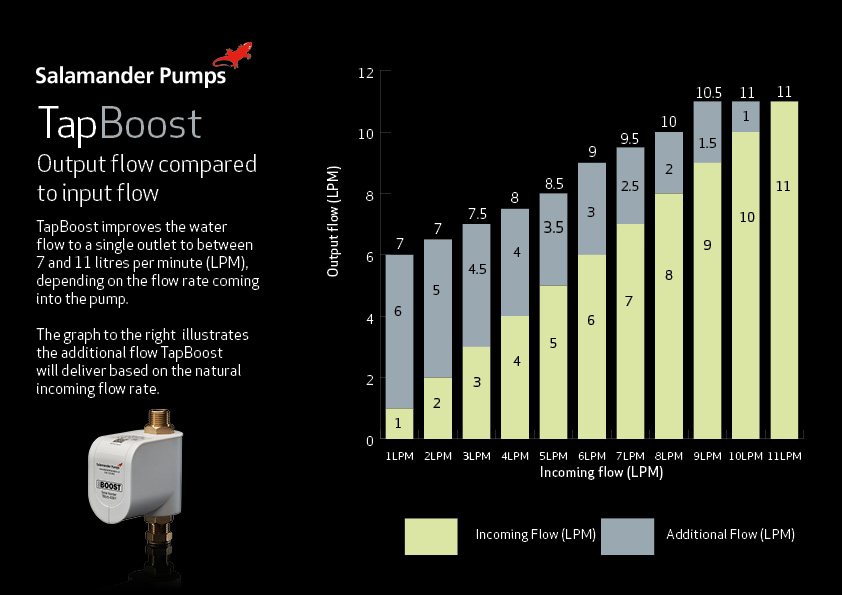
When the incoming natural flow reaches 11 L/min, TapBoost will go into idle mode and stop boosting the flow to ensure it is never pumping more than 12 L/min, remaining in line with the Water Regulations.
The temperature of the water passing through TapBoost should be between 4°C – 65°C. Temperatures outside of this range may cause damage to the pump.
TapBoost operates at 34dBA.
TapBoost should never be installed to restrictive or collapsed pipework or supply, such as a lead main.
TapBoost can be installed on a shared main provided that it is only being used to boost a single outlet within one property, as highlighted by the typical installations image.
TapBoost can be installed on a hot or cold outlet in a gravity-fed system. However, there must be a minimum natural flow of 1.2 L/min from the outlet to be boosted.
TapBoost can be installed in combi boiler systems to boost either a hot or cold outlet.
TapBoost cannot be installed on hot water pipes/outlets from an unvented system – TapBoost should only be fitted to a cold-water outlet in unvented systems.
There must be a minimum natural flow of 1.2 L/min from any outlet to be boosted.
Yes. TapBoost can be installed in certain zones within a bathroom, however the plug/power supply must be outside of the bathroom and the installation must adhere to the latest I.E.E. electrical regulations. Refer to the *installation manual* for more information.
TapBoost is not suitable for boosting multiple outlets.
If multiple outlets suffer with poor performance in a mains-fed system a larger inline pump or accumulator tank should be installed – click here to view our full MainsBooster range.
When more than one outlet suffers with poor water performance in a gravity-fed system then a bathroom or whole house pump should be installed – click here to view our full GravityBooster range.
Yes, however there must be sufficient natural flow/pressure to allow the electric shower to operate before installing a TapBoost. Please note, many electric showers are restrictive by their nature, and you should check with your electric shower manufacturer to see if the maximum flow rate from the shower is already being achieved.
Yes, TapBoost can be used to boost outlets providing drinking water such as kitchen taps.
TapBoost can be used on communal supplies provided that it is only being used to boost a single outlet within one property, as highlighted by the typical installations image.
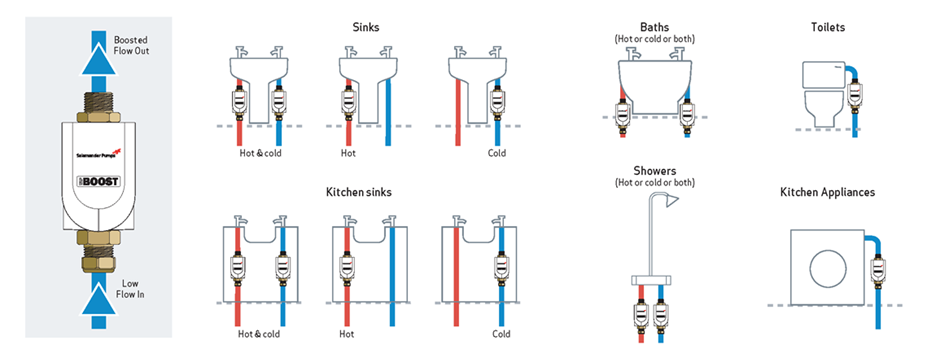
TapBoost can be installed horizontally or vertically however for optimum performance it is better fitted vertically. Never install TapBoost upside down or against the direction of flow.
No, two TapBoost pumps in-line will not deliver double the flow and TapBoost must not be installed in this way. If a single TapBoost does not provide adequate flow, please consider one of our other products:
Our MainsBooster range features larger inline pumps and accumulator tank which will provide greater flow rates in mains-fed systems.
Our GravityBooster range includes pumps which will deliver higher flow rates in gravity-fed system
TapBoost should be fitted as close to the poorly performing outlet as possible.
Yes. The power pack and cables supplied with TapBoost must be used to power the pump. The supplied power pack and cables have been certified for use with TapBoost to ensure that they comply to the UK safety standards. The use of other power packs will invalidate the warranty.
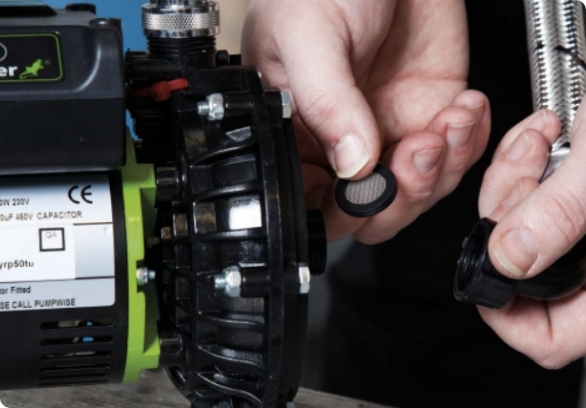
Yes, the filter prevents debris and foreign objects entering the pump. Should the filter become blocked it can be removed for cleaning and then replaced. A spare filter is also provided in the box.
TapBoost is supplied with a filter pre-fitted to the inlet and a spare filter in the box. The flat face of the filter should be inserted into the inlet port until the flat face sits flush with the pipe stop.
TapBoost has a 15mm compression fitting on the inlet and a ½” BSP male connection on the outlet.
TapBoost has a 15mm compression fitting on the inlet to allow installation directly onto pipework. The outlet has a ½” BSP male thread allowing any suitable connection to be attached. When installed on mains water applications, no detachable hose sets should be used. If a flexible hose is used for connection to a gravity fed system, it should be no longer than 300mm.
The 15mm compression fitting on the inlet allows TapBoost to be installed directly onto pipework and the ½” BSP male connection allows flexibility for TapBoost to be installed in a range of applications, allowing TapBoost to be adaptable depending on the installation requirements.
The TapBoost power supply unit has a green LED which will illuminate when there is power to the supply unit.
The TapBoost pump is fitted with a blue LED to indicate its status. The image shows the location of the LED.
When the pump is in ‘standby mode’ (electrical supply to the pump but the outlet is not open) the LED will remain solid for 5 minutes. After 5 minutes the LED will turn off, but the pump will remain in ‘standby mode’.
A fast-flashing LED indicates that the pump is in ‘boosting mode’ (outlet is open and TapBoost is boosting the flow).
When the outlet is closed, TapBoost will then enter ‘standby mode’ where the LED will remain solid for 5 minutes as described above.
TapBoost intelligently monitors the flow of water. If the flow reaches 11 lpm or more, it will enter ‘idle mode’ indicated by a slow pulsing blue LED. The pump continues to monitor the flow but will not provide any additional boost. If the flow drops below 11 lpm, the pump will again switch to ‘boosting mode’ indicated by a fast-flashing blue LED.
All pumps will make some noise, as water is being moved at a high speed and being thrust out of a pump. Depending on the type of pump, water will be moved in different ways and therefore different pumps can make noises.
If the HomeBoost pump is making an unusual noise, it is worth checking the installation is correct and eliminate contributing factors to the operational noise such as transfer noise:
First check to see if there is a green light on the transformer unit.
If there isn’t then:
If there still isn’t a green light, then the power cable will need to be replaced so please call us on 0191 516 2002.
If the green light is illuminated on the powerpack but the TapBoost still isn’t activating then please check to see if the blue light on the top of the pump is lit.
If it isn’t:
If the TapBoost still isn’t activating then you need to call us 0191 516 2002.
If the blue light is illuminated then please check the flow rate to the outlet, you can find details of how to do that here.
If your flow rate is more than 1.2L/min and the pump still isn’t activating then please call us on 0191 516 2002.
If your flow rate is less than 1.2 L/min then TapBoost won’t work as it needs this minimum flow rate to activate the pump.
In normal operation TapBoost is relatively quiet so if it has become noisy it could be because one of the following:
If TapBoost continues to run when the outlet is closed please check the following:
If this doesn’t solve the problem then there may be an issue with the pump, so please call us on 0191 516 2002.
We have designed our products to be as quiet as possible, but it is worth noting that there is some noise associated with the operation of our products. HomeBoost operates at 46dBA and has been awarded the Quiet Mark for being amongst the quietest in its category.
If you think your HomeBoost is noisier than it should be carry out the following –
If the pipework supplying the pump isn’t secured properly, the vibrations from the pump may cause it to rattle. Make sure that the pipework is clipped.
First, check the power supply to the pump.
Then check the natural flow of mains water is sufficient to activate the pump.
In compliance with the Water Supply (Water Fittings) Regulations 1999, our range of inline pumps will not pump water if the natural mains flow rate is greater than 12 L/min.
An accumulator tank stores water under pressure to provide an excellent solution for properties requiring additional boost to mains water flow and pressure
First check that the pump is powerful enough for what you’d like to do. Each shower you want to run will require 1 bar pressure, so if you’d like to run two showers at the same time you’ll need a two bar pump. If multiple showers are being used at the same time, then a drop in performance may occur if the pump is undersized.
Ensure the flow rate is not reduced by keeping AV couplers as straight as possible to prevent starvation. Blocked filters may also reduce the flow and cleaning them may be a quick fix to improving flow rates.
The pump on an AccuBoost accumulator turns on when it recognises the system pressure has dropped below its activation threshold. The minimum pressure to activate the pump on an AccuBoost accumulator is 1.4 bar.
When an outlet, such as a shower or tap, is turned on the system pressure decreases. So if only a small amount of water is used, the pressure may not decrease by enough to reach the minimum pressure required to activate the pump.
If the pump on the accumulator is running on/won’t turn off it could mean that the vessel has not reached full water capacity and the pump is still running to fill. It could also indicate a leak in system. Allow sufficient time for vessel to reach full capacity (this can vary between 5-40 mins depending on vessel size) and check all outlets are closed and there are no leaks on the pipework.
Customer Support
Find an Installer
Visit our installer map to search for an installer in your local area.
Find an installer
Warranty Registration
Provide your installation details in our quick and easy form to register your product's warranty.
Register your warranty
Shop Accessories
The Salamander Pumps' accessories can aid installation, protect the pump from common causes of damage and assist in minimising the noise of the installation.
Shop now


